
Chewy vs. Local Pet Stores: Where Should You Buy Prescription Pet Food?

- 0
- 0

Compare convenience, veterinary support, pricing, availability, and product safety before choosing where to purchase your pet’s therapeutic diet.
When a veterinarian recommends prescription pet food, the decision is not always as simple as choosing the lowest price. You may need to consider authorization, product availability, delivery times, storage, diet changes, and how quickly your veterinarian can help if your pet’s condition changes.
Chewy and local pet stores can both be useful options. Chewy may offer convenience, subscriptions, home delivery, and a broad online selection. A local pet store may provide immediate access, personal service, and the opportunity to speak with staff in person.
The right choice depends on your pet’s medical needs, your location, the urgency of the purchase, and how much veterinary support you require.
Important: Prescription and therapeutic diets should be used according to your veterinarian’s recommendation. This article is general information and does not replace veterinary advice.
What Is Prescription Pet Food?

Prescription pet food, often called a veterinary or therapeutic diet, is formulated for specific health needs.
Veterinarians may recommend a therapeutic diet for conditions such as:
-
Kidney disease.
-
Urinary problems.
-
Food allergies or sensitivities.
-
Gastrointestinal disorders.
-
Diabetes.
-
Weight management.
-
Liver disease.
-
Recovery from illness.
-
Dental health.
-
Certain joint or mobility concerns.
These diets are not interchangeable. A food designed for urinary support may not be appropriate for a pet with kidney disease, and a weight-management diet may not meet the needs of an underweight or recovering animal.
The correct product, feeding amount, and duration depend on your pet’s diagnosis, age, weight, medications, and overall health.
In the United States, pet-food labeling and disease-related marketing are regulated by the FDA, and the agency advises pet owners to discuss their pet’s health and the use of veterinary diets with a veterinarian.
Chewy: Main Advantages
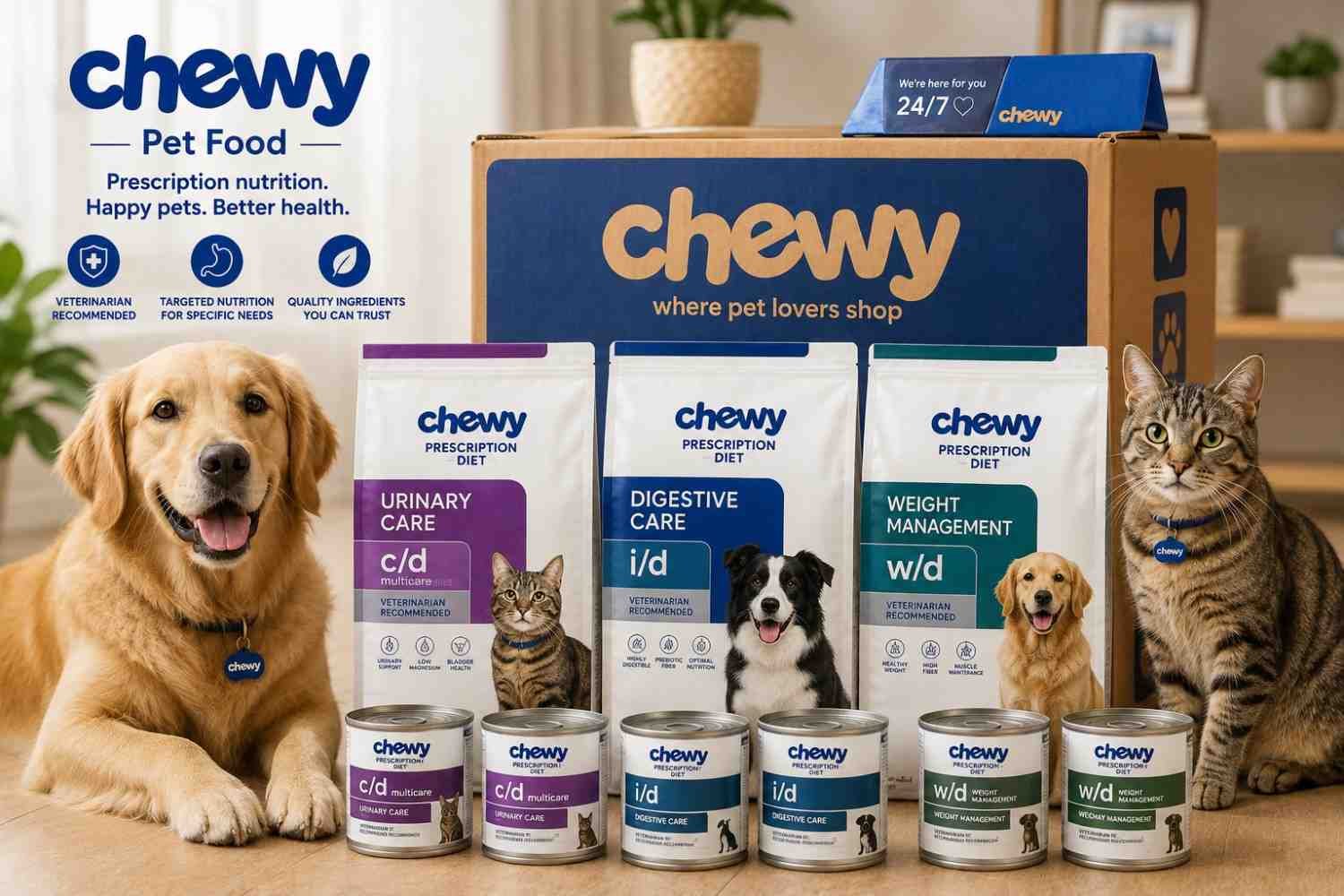
Convenient home delivery
Chewy can be helpful when you have a busy schedule, limited transportation, mobility concerns, or a pet that needs a diet delivered regularly.
You can order online and have the food shipped to your home instead of making repeated trips to a store or veterinary clinic.
Broad product selection
Online retailers may offer multiple sizes, flavors, textures, and formulas. This can be useful if your pet prefers wet food, needs a particular package size, or has difficulty with a product that is temporarily unavailable locally.
Prescription authorization process
Chewy’s veterinary-diet ordering process asks for your pet’s information and veterinary clinic details so the company can confirm authorization. Customers may also submit an existing authorization through the platform.
Authorization procedures can vary by product and location, so check the current instructions at checkout.
Reordering and subscriptions
Recurring delivery can reduce the risk of running out of food. This may be useful for pets that need a therapeutic diet continuously.
However, subscriptions should be reviewed regularly. Your veterinarian may change the food, feeding amount, or duration of the diet as your pet’s health changes.
Easy price comparison
Online ordering makes it easier to compare package sizes, unit prices, discounts, and shipping terms.
Do not compare only the sticker price. Consider:
-
Price per kilogram or pound.
-
Shipping charges.
-
Subscription discounts.
-
Delivery delays.
-
Refund policies.
-
Product availability.
-
The amount your pet needs each day.
Chewy: Possible Disadvantages
Delivery delays
If your pet is almost out of food, an online order may not arrive in time. Weather, carrier problems, inventory changes, or authorization delays can affect delivery.
Do not wait until the last serving to reorder a medically important diet.
Less immediate personal support
Online customer service can help with ordering and logistics, but it does not replace your veterinarian’s clinical judgment.
If your pet refuses the food, develops new symptoms, vomits repeatedly, or loses weight, contact your veterinary clinic rather than relying only on a retailer’s product information.
Authorization problems
Orders may be delayed if:
-
The clinic cannot be reached.
-
The prescription or authorization has expired.
-
The product does not match the veterinarian’s instructions.
-
Your pet’s information is incomplete.
-
The requested diet is unavailable.
-
The clinic requires a recheck before approving more food.
Confirm the authorization process before placing an urgent order.
Storage and shipping concerns
Food may be exposed to heat, cold, moisture, or rough handling during transportation. Inspect the package when it arrives.
Do not use food if the packaging is damaged, swollen, leaking, punctured, wet, or unusually discolored. Contact the retailer and ask your veterinarian whether you should use a replacement product.
Local Pet Stores: Main Advantages

Immediate availability
A local store may be the fastest option if your pet is running out of food and the product is in stock.
You can inspect the package, check the expiration date, and take the food home immediately.
Personal service
Some independent pet stores have experienced staff who can help you locate the correct formula, compare package sizes, or identify similar products to discuss with your veterinarian.
Staff advice can be useful for shopping decisions, but it should not override veterinary instructions about a medical diet.
Easier product inspection
Buying locally allows you to check:
-
Seal integrity.
-
Expiration date.
-
Package condition.
-
Can or pouch damage.
-
Storage conditions.
-
Product size.
This can be reassuring when your pet depends on a specific formula.
Supporting local businesses
Purchasing locally keeps money in your community and may help maintain access to independent pet-care advice and specialty products.
Local stores may also be able to order a product for you if they do not currently have it in stock.
Local Pet Stores: Possible Disadvantages
Limited selection
A small store may not carry every veterinary formula, flavor, package size, or brand.
You may need to place a special order or visit several locations.
Higher prices
Local operating costs can affect pricing. The local option may cost more than an online retailer, although the difference may be offset by immediate access and the absence of shipping delays.
Inconsistent inventory
Therapeutic diets can sell quickly or become temporarily unavailable. Call ahead before making a trip.
No automatic reordering
Some stores may not offer subscriptions or reminders. You will need to track your supply manually.
Chewy vs. Local Pet Stores
| Factor | Chewy | Local pet store |
|---|---|---|
| Convenience | Home delivery and online ordering | Requires a store visit |
| Product selection | Often broad, depending on inventory | May be more limited |
| Speed | Depends on shipping and authorization | Immediate if in stock |
| Price comparison | Easy to compare online | May require visiting or calling stores |
| Personal service | Online or phone support | Face-to-face assistance |
| Package inspection | Possible after delivery | Possible before purchase |
| Recurring orders | Often available | May not be available |
| Urgent replacement | Risk of delivery delay | Useful if product is in stock |
| Veterinary relationship | Authorization may be verified remotely | Some stores may coordinate locally |
| Best use | Routine, planned reorders | Immediate needs and local support |
Which Option Is Better for Routine Purchases?
Chewy may be a strong choice for planned, repeat purchases when:
-
Your pet has been stable on the diet.
-
Your veterinarian has approved continued use.
-
You order before your supply is low.
-
The food is reliably available.
-
You want home delivery.
-
You benefit from recurring orders.
-
You can monitor your pet’s response at home.
A local store may be preferable when:
-
You need food immediately.
-
You want to inspect the package.
-
The product is available nearby.
-
You need help finding a different size or texture.
-
Delivery is unreliable in your area.
-
You prefer supporting a local business.
Many pet owners use both options: a local store for emergencies and an online retailer for planned replenishment.
What If Your Pet Is Running Out?
Do not wait until the last day.
Call your veterinarian if:
-
You cannot find the prescribed diet.
-
The product is out of stock.
-
Your pet needs a diet change.
-
The authorization is delayed.
-
Your pet refuses the food.
-
Your pet has developed vomiting, diarrhea, lethargy, or appetite loss.
-
You are considering substituting another product.
Do not switch to a different therapeutic formula solely because the packaging looks similar. Ask your veterinarian what temporary alternative, if any, is appropriate.
In some cases, a short interruption may be more concerning than in others. The risk depends on the underlying condition and the reason the diet was prescribed.
How to Order Safely From Chewy
.jpg)
Before ordering:
-
Confirm the exact brand, formula, flavor, texture, and package size.
-
Check that the authorization is current.
-
Enter your pet’s name and veterinary-clinic information accurately.
-
Order early enough to allow for processing and delivery.
-
Review the expiration date and package condition on arrival.
-
Store the food according to the label.
-
Monitor your pet’s appetite, stool, weight, and symptoms.
-
Contact your veterinarian before making a diet change.
If you use automatic delivery, update the schedule when your veterinarian changes the feeding amount or product.
Chewy also states that its virtual veterinary service may authorize veterinary diets when its veterinarian determines they are medically appropriate, but availability and rules depend on the service and location.
How to Buy Safely From a Local Store
Before visiting:
-
Call to confirm the exact product is in stock.
-
Ask whether the package can be held for you.
-
Verify the size and formula.
-
Ask about return or exchange policies.
-
Bring a photograph of the product label if you are unsure.
At the store:
-
Check the expiration date.
-
Inspect cans, bags, and pouches for damage.
-
Avoid swollen, leaking, punctured, or unsealed packaging.
-
Confirm that the product matches your veterinarian’s instructions.
-
Store the food promptly after purchase.
If staff recommend a substitute, contact your veterinarian before feeding it.
Price: Look Beyond the Sticker
Prescription pet food can be expensive, especially for large dogs or pets that require wet food.
Compare the actual cost using:
Cost per day = Package price / Number of feeding days
A larger package may have a lower unit cost, but it is not always the best choice if your pet cannot finish it before the food loses freshness.
Also consider:
-
Daily feeding amount.
-
Wet versus dry formulation.
-
Shipping fees.
-
Subscription discounts.
-
Local sales tax.
-
Delivery frequency.
-
Food waste.
-
Emergency replacement costs.
Your veterinarian can help determine the appropriate daily quantity.
What If Your Pet Does Not Like the Food?

Some pets reject a new therapeutic diet because of unfamiliar taste, texture, smell, stress, or an underlying illness.
Do not force a prolonged food refusal without contacting your veterinarian. Cats, in particular, can become medically vulnerable when they do not eat.
Your veterinarian may suggest:
-
A gradual transition.
-
A different texture or flavor within the same diet range.
-
Warming wet food slightly.
-
Adjusting meal size and frequency.
-
Checking for nausea, dental pain, or another medical issue.
-
Choosing an approved alternative formula.
Never assume that a food labeled “sensitive,” “natural,” or “premium” is equivalent to a veterinary therapeutic diet.
What About Prescription Pet Food in Canada?
Rules and product classifications differ between countries. A diet or product marketed as veterinary or therapeutic in one country may be handled differently in another.
Canadian pet owners should confirm:
-
Whether the product is available for Canadian delivery.
-
Whether the veterinarian’s authorization is accepted.
-
Whether the product is approved or distributed in Canada.
-
Whether import restrictions apply.
-
Whether the retailer has a Canadian ordering process.
-
Whether the diet is appropriate for the pet’s diagnosis.
Do not assume that information about U.S. prescription products applies automatically to Canadian purchases. Canada’s rules for medicated feeds and veterinary products can involve written veterinary authorization and specific conditions.
The Best Choice by Situation
Choose Chewy when:
-
You need regular home delivery.
-
Your pet’s diet is stable.
-
You want a broad online selection.
-
You prefer automatic reordering.
-
You have time for authorization and shipping.
-
You can order well before running out.
Choose a local pet store when:
-
You need the food today.
-
The exact product is in stock.
-
You want to inspect the package.
-
You prefer face-to-face help.
-
Online delivery is delayed or unavailable.
-
You want to support a local business.
Contact your veterinarian first when:
-
Your pet’s diagnosis has changed.
-
Your pet refuses the prescribed diet.
-
Your pet develops new symptoms.
-
The food is unavailable.
-
You want to change brands or formulas.
-
You are unsure whether the diet is still necessary.
-
Your pet is losing or gaining weight unexpectedly.
Final Thoughts
Chewy and local pet stores can both be good places to buy prescription pet food. Chewy offers convenience, online selection, recurring delivery, and easy price comparison. Local stores offer immediate access, personal service, and the ability to inspect products before purchase.
The best approach is to match the retailer to the situation. Use planned online ordering for stable, recurring needs, and keep a local backup option for urgent replacements.
Most importantly, treat prescription pet food as part of your pet’s healthcare plan—not simply as another grocery item. Follow your veterinarian’s instructions, order early, verify the exact formula, and ask for professional guidance before changing the diet.


Comments
No comments yet. Be the first to share your thoughts.