
How to Train a Golden Retriever: Everything You Need to Know


Key Takeaways
- Golden Retrievers rank #4 in dog intelligence according to Stanley Coren's The Intelligence of Dogs - behind only the Border Collie, Poodle, and German Shepherd.
- The training window opens at 8 weeks. Waiting until 6 months is one of the most common - and costly - mistakes new owners make.
- Positive reinforcement only. Goldens are sensitive dogs. Punishment-based methods don't just fail - they actively damage the relationship and can create lasting anxiety.
Why Golden Retrievers Are Easy (and Hard) to Train

Let's be honest about both sides of this.
On the easy side: Goldens are food-motivated, eager to please, highly intelligent, and genuinely love attention from their people. That combination is a trainer's dream. They pick up new commands quickly, they want to engage with you, and they're not trying to outsmart you the way a Border Collie might. For first-time dog owners, this breed is about as forgiving as it gets.
On the hard side: Golden Retriever puppies are high-energy, easily distracted, and have the attention span of a golden-haired tornado. A 10-week-old Golden doesn't ignore your "sit" cue because it's stubborn - it's because a leaf just blew past the window. Add to that a strong predisposition to separation anxiety (more on that later), and you have a dog that genuinely needs structured training, not just occasional commands.
The honest take: Goldens are one of the easiest breeds for first-time owners, full stop. But "easy to train" has been oversold to the point where people bring home a puppy expecting it to arrive pre-trained. It won't. Consistency, repetition, and time are still the price of admission - the Golden just makes that investment more enjoyable than most.
The Golden Rule - Positive Reinforcement Only
If there's one thing to take from this guide, it's this: do not use punishment-based methods on a Golden Retriever.
This isn't just a philosophical preference. Goldens are a sensitive breed. They read human emotion closely, they bond intensely, and they shut down under pressure. A harsh correction that a Labrador might shake off in 30 seconds can cause a Golden to disengage entirely - from the session, from you, and eventually from training itself. You'll end up with a dog that's anxious, avoidant, and harder to work with than before you started.
What positive reinforcement actually looks like in practice:
- Timing is everything. Mark the exact moment the correct behavior happens - either with a clicker or a clear verbal marker like "yes!" - then deliver the reward within 1–2 seconds. The mark tells the dog precisely what earned the reward.
- Clicker training basics: Charge the clicker first (click → treat, click → treat, 10 times in a row) before using it in training. Once the dog understands the click means a reward is coming, you have a precise communication tool.
- Reward hierarchy for most Goldens: food > play > praise. High-value treats (small pieces of chicken, cheese, or commercial training treats) outperform verbal praise when teaching new behaviors. Once a behavior is reliable, you can fade food rewards and mix in praise and play - but don't start there.
The Association of Professional Dog Trainers (APDT) formally endorses positive reinforcement as the first-line approach for all dog training, and their LIMA (Least Intrusive, Minimally Aversive) framework is worth reading if you want to understand the reasoning behind it.
Puppy Training - Start at 8 Weeks
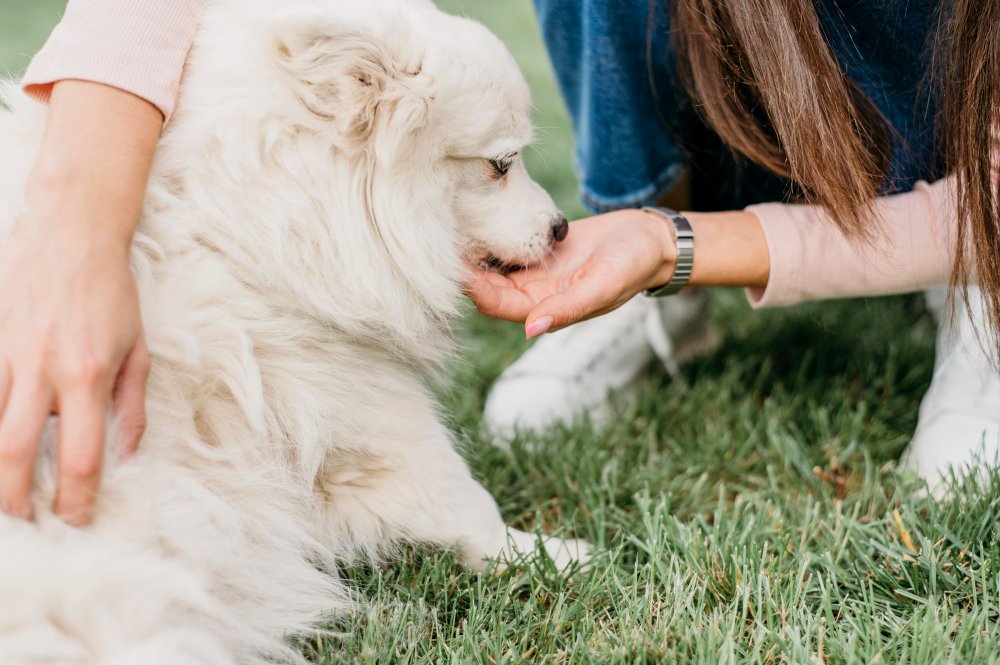
Eight weeks is not too young. Eight weeks is exactly right. The earlier you establish routines, the easier everything that follows becomes.
First Week Home
The first week is about structure, not performance. Your puppy doesn't need to learn "sit" on day one - it needs to learn that its new environment is safe, predictable, and consistent.
- Establish a daily routine immediately. Fixed feeding times, toilet trips, play sessions, and sleep schedules reduce anxiety and speed up housebreaking. Puppies thrive on predictability.
- Introduce the crate as a safe space, not a punishment. Feed meals near the crate, toss treats inside, let the puppy explore it voluntarily before closing the door. A crate should be a den, not a jail.
- Teach name recognition. Say the puppy's name in a cheerful tone, and the moment it looks at you, mark and reward. Do this 20–30 times a day. It's the foundation of every command that follows.
Housebreaking
The schedule: Take your puppy outside every 2 hours, plus immediately after eating, drinking, playing, and waking from a nap. That sounds like a lot - because it is. Puppies have tiny bladders and zero impulse control.
Accident protocol: Clean immediately with an enzyme-based cleaner (standard cleaners don't break down the scent compounds, so the dog will return to the same spot). No punishment - not even a stern "no." The puppy has no idea why you're upset, and punishment after the fact teaches nothing except that you're unpredictable.
Timeline: Most Goldens reach reliable housebreaking between 4–6 months, though some take longer. If accidents are still frequent past 6 months, rule out a medical issue (urinary tract infection, for example) before assuming it's a training problem.
Core Commands - Teach in This Order
Work through these sequentially. Each one builds on the last.
- Sit - the foundation of impulse control
- Down - builds on sit, useful for calm behavior
- Stay - duration and distance, added gradually
- Come - recall; covered in depth below
- Leave It - critical safety command
- Drop It - essential for a retriever who will pick up everything
Session length: 5–10 minutes maximum for puppies. Run 2–3 sessions per day rather than one long one. Always end every session on a win - finish with a behavior the dog knows well so the session ends on a positive note.
Socialization - The 3–14 Week Window
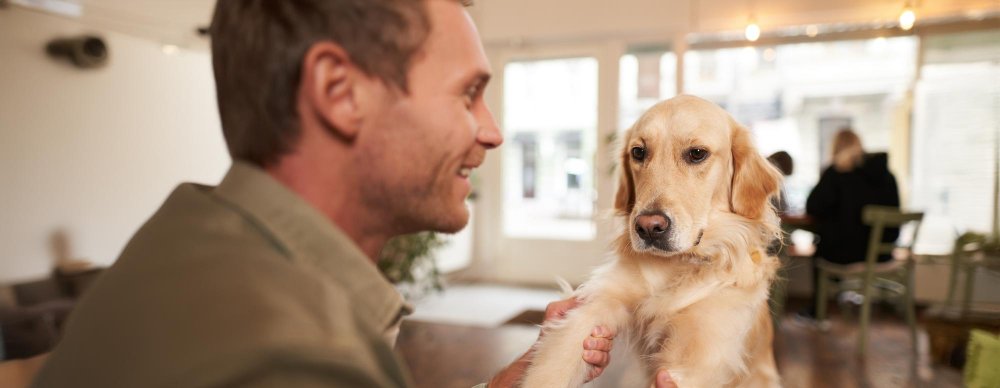
This section matters more than any command you'll ever teach.
The critical socialization period runs from approximately 3 to 14 weeks. Experiences during this window shape a dog's behavior for life - far more than training ever will. A Golden that misses adequate socialization during this period is significantly more likely to develop anxiety, reactivity, and fear-based behaviors as an adult, regardless of how much training follows.
What to expose your puppy to:
- People of different ages, sizes, and appearances (hats, beards, uniforms, wheelchairs)
- Other vaccinated, friendly dogs
- Traffic sounds, construction noise, thunder recordings
- Different surfaces: grass, gravel, tile, metal grates, stairs
- Handling: ears, paws, mouth, tail - essential for vet visits
Puppy classes are the single best investment you can make during this period. They provide controlled socialization with other puppies and humans, introduce basic obedience in a distraction-rich environment, and give you direct access to a trainer's feedback. Don't skip them because you think you can handle it at home - you probably can't replicate the socialization component.
The #1 mistake new Golden owners make is under-socialization. They keep the puppy home "until it's fully vaccinated," which often means missing the critical window entirely. Talk to your vet about a risk-balanced approach - most support attending well-run puppy classes before the vaccine series is complete.
Leash Training
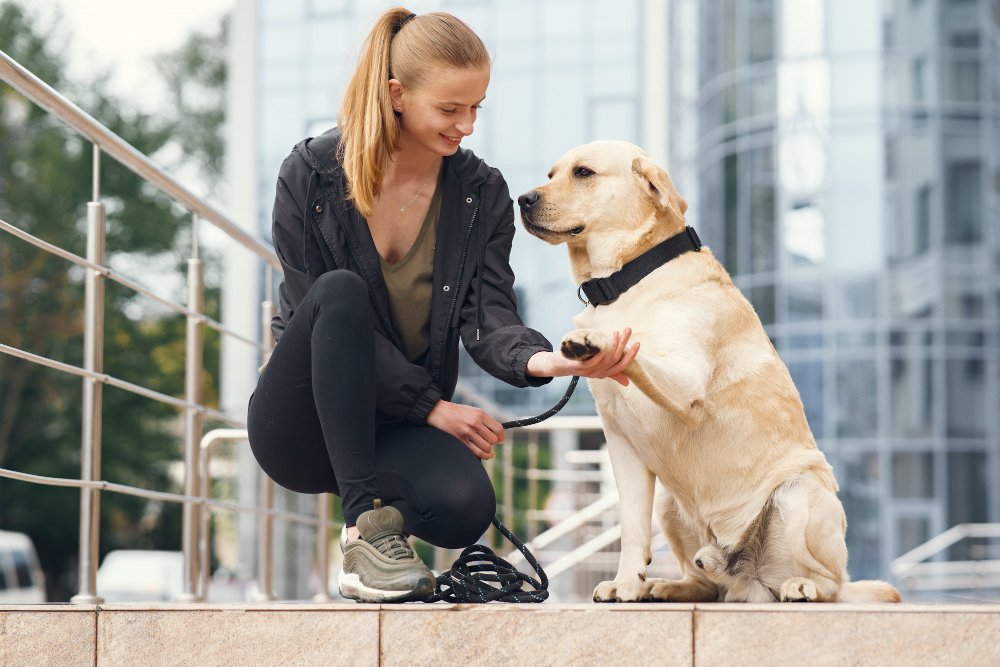
Start indoors before you ever clip a leash to a collar outside. Let the puppy drag a lightweight leash around the house first so the sensation is familiar before you add the complexity of the outdoors.
Loose-leash walking is built on one simple rule: forward movement is the reward. The moment the leash tightens, you stop. When the dog returns to your side and the leash goes slack, you mark and reward, then move forward again. It's slow at first. Stick with it.
For dogs that pull hard: a front-clip harness redirects the dog toward you when it pulls, making the behavior self-correcting without any pain or pressure. It's not a permanent fix - it's a management tool while you build the behavior - but it makes the process significantly easier.
The mistake that creates 65-pound pulling machines: letting puppies pull "because they're small and it's cute." It is not cute. It's a habit being reinforced every single walk. The 10-pound puppy that drags you to the mailbox becomes the 65-pound adult that dislocates your shoulder. Start loose-leash work from the first walk.
Recall Training - The Most Important Command
Off a leash, in an emergency, at a dog park - reliable recall can save your dog's life. It deserves more attention than most owners give it.
The golden rule of recall: never call your dog to punish it. Not once. Not even when you're furious that it took five minutes to come back. If "come" ever predicts something unpleasant - a bath, the end of playtime, a scolding - the dog will start avoiding it. "Come" must always, without exception, predict something wonderful.
How to build reliable recall:
- Start in a low-distraction environment (your living room). Call the dog's name + "come," and when it arrives, throw a party - treats, praise, play, whatever the dog loves most.
- Move to the backyard, then a quiet park, then progressively more distracting environments. Only add difficulty when the previous level is solid.
- Use a long line (20–30 feet) to practice recall in open spaces before going off-leash. The long line gives the dog freedom while keeping you in control if it doesn't respond.
- Never repeat the cue. Say "come" once. If the dog doesn't respond, use the long line to guide it toward you, then reward anyway. Repeating "come, come, come, COME" teaches the dog that the first three don't count.
Common Behavioral Problems (and How to Fix Them)
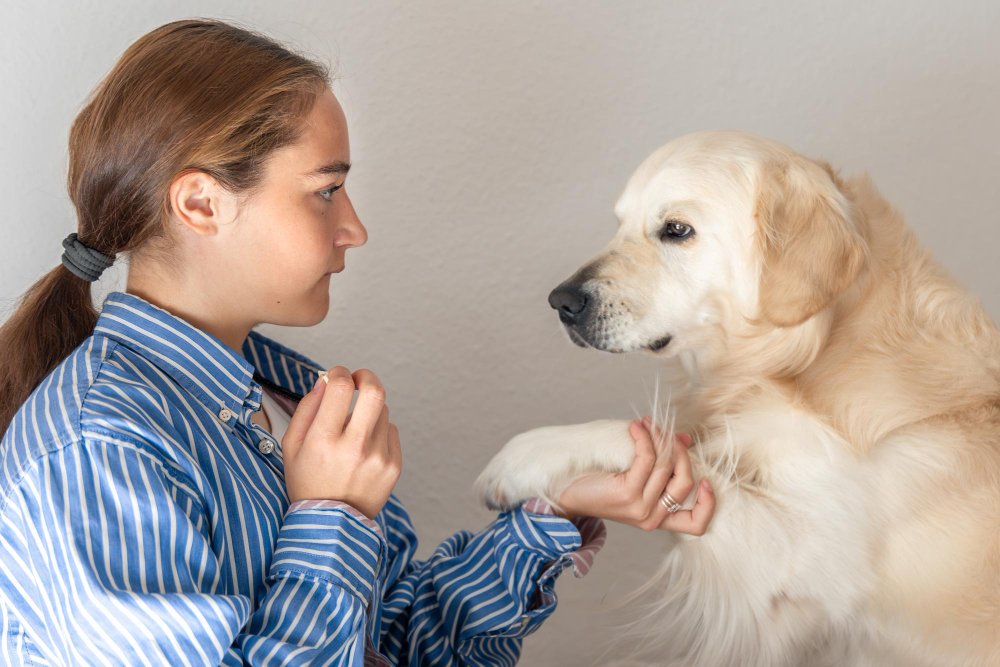
Jumping Up
Why they do it: Goldens jump because it works. Someone, at some point, gave them attention - even negative attention - when they jumped. That's all the reinforcement they needed.
The fix: Turn away completely. No eye contact, no "off," no pushing them down (pushing is physical contact, which is rewarding). The moment all four paws hit the floor, mark and reward immediately. The critical piece: every person in the household must do this every time. One family member who lets the dog jump "just this once" resets weeks of progress.
Mouthing and Nipping
Normal puppy behavior - not aggression, not a red flag. Puppies explore with their mouths and learn bite inhibition through feedback.
The fix: When the puppy mouths too hard, yelp sharply and immediately withdraw all attention - turn away, stand up, leave the room if needed. Wait 30 seconds, then re-engage. Redirect to an appropriate chew toy. Never rough-play with your hands as toys - you're teaching the dog that hands are fair game.
Excessive Barking
In Goldens, excessive barking is almost always boredom or attention-seeking, not territorial aggression. A Golden that barks constantly is a Golden that isn't getting enough physical exercise (60+ minutes daily for adults) or mental stimulation.
The fix: Identify the trigger. Increase exercise and enrichment. Teach the "quiet" command by waiting for a natural pause in barking, then marking and rewarding the silence. Do not shout at the dog to stop barking - you're just barking back, and it escalates the behavior.
Separation Anxiety
Goldens bond intensely. It's one of their best qualities and one of their biggest vulnerabilities. Left unaddressed, separation anxiety can result in destructive behavior, self-injury, and significant distress - not just inconvenience.
Prevention (start from puppyhood):
- Practice short absences from day one. Step outside for 30 seconds, come back, act normal.
- Don't make arrivals and departures dramatic. No long goodbyes, no excited reunions. Matter-of-fact departures and calm returns reduce the emotional weight of being left alone.
If anxiety is already established: graduated desensitization is the evidence-based approach - absences so short the dog never reaches the anxiety threshold, then incrementally increased over weeks. This is slow, methodical work. The ASPCA's separation anxiety resources are an excellent starting point. For moderate to severe cases, a certified veterinary behaviorist (DACVB) or a certified applied animal behaviorist (CAAB) - not just a general trainer - is the appropriate professional to consult.
Advanced Training and Activities
Once your Golden has solid basic obedience, the real fun begins. This breed was built to work, and a Golden with a job is a happy, calm, well-adjusted dog.
Goldens excel at:
- Obedience trials - their precision and handler focus make them natural competitors
- Agility - high energy + intelligence = a great combination for obstacle courses
- Nose work / scent detection - mentally exhausting in the best possible way
- Therapy dog work - their gentle temperament and love of people make them ideal
- Dock diving - if your Golden loves water (most do), this is pure joy
- Hunting and field work - what the breed was originally developed for; instincts run deep
Mental stimulation is not optional. A bored Golden is a destructive Golden. Physical exercise alone isn't enough - the brain needs work too. Puzzle feeders, sniff walks (where the dog sets the pace and follows its nose), and training games count as enrichment and should be part of the daily routine.
When to Hire a Professional Trainer
There's no shame in getting help - experienced trainers see things owners miss, and the investment pays off for the dog's entire life.
Puppy kindergarten: Recommended for all first-time owners, full stop. Even if you've read every book, the real-world socialization and trainer feedback are irreplaceable.
Group obedience classes: Good for socialization alongside basic command work. Ideal for adolescent dogs (6–18 months) going through the "I've forgotten everything" phase.
Private trainer: For specific behavioral issues - reactivity, resource guarding, persistent jumping, leash aggression. A private trainer can observe the dog in its actual environment and tailor the approach.
Certified behaviorist (DACVB or CAAB): For serious cases - established separation anxiety, fear-based aggression, compulsive behaviors. These are not training problems; they're behavioral and sometimes medical issues that require a specialist.
Red flags to walk away from: Any trainer who recommends prong collars, shock collars (e-collars used for correction), or frames their approach around "alpha" or "dominance" theory. These methods are not appropriate for Golden Retrievers - or for most dogs. The APDT's position on training methodologies is a useful reference when evaluating a trainer's approach.
To find certified trainers in your area, look for credentials from the Certification Council for Professional Dog Trainers (CCPDT-KA or CPDT-KSA), the International Association of Animal Behavior Consultants (IAABC), or Karen Pryor Academy (KPA-CTP). Local directories and breed clubs often maintain vetted referral lists.
Petzooie's Take
Petzooie's Take: Training a Golden Retriever is genuinely one of the most rewarding experiences in dog ownership - but the breed's reputation for being "easy" has been badly oversold. Goldens still need structure, consistency, and your actual time. The owners who skip puppy class, skip socialization, and wonder why their two-year-old Golden is a 65-pound chaos machine are the ones who believed the marketing. The good news: if you put in the work early, you get a decade-plus of one of the best dogs on earth. That's a trade worth making.
Frequently Asked Questions
Are Golden Retrievers easy to train?
Yes - relative to most breeds. Goldens are food-motivated, eager to please, and rank #4 in Stanley Coren's working intelligence rankings. That said, "easy to train" doesn't mean effortless. Puppies are distractible and high-energy, and without consistent structure, even a Golden will develop bad habits. Expect to invest real time, especially in the first year.
When should I start training my Golden Retriever puppy?
The moment it comes home - typically at 8 weeks. There is no "too young" for basic routines, name recognition, crate introduction, and socialization. Waiting until 4–6 months means missing the most critical developmental window of the dog's life.
How long does it take to train a Golden Retriever?
Basic obedience (sit, down, stay, come, leave it) can be reliable within 4–8 weeks of consistent daily training. Housebreaking typically takes 4–6 months. Reliable off-leash recall in high-distraction environments can take 6–12 months of progressive work. Training, in the broader sense, is ongoing throughout the dog's life.
Why does my Golden Retriever ignore me when I call them?
Usually one of three reasons: the recall cue has been poisoned (calling the dog to punish it or end something fun), the environment is too distracting for the dog's current skill level, or the cue has been repeated so often without response that the dog has learned to tune it out. Start over in a low-distraction environment, rebuild the positive association with "come," and use a long line until recall is reliable.
Should I use a shock collar on a Golden Retriever?
No. Shock collars (e-collars used for aversive correction) are not appropriate for this breed. Goldens are sensitive dogs that shut down under pressure, and aversive methods can cause lasting anxiety, fear, and damage to the human-dog bond. Positive reinforcement achieves the same results - faster, more reliably, and without the side effects. The APDT, ASPCA, and most veterinary behavior organizations oppose their use for companion dog training.
How do I stop my Golden Retriever from jumping on people?
Consistency is the entire answer. Every person the dog encounters must respond the same way: turn away, no eye contact, no verbal response. The moment four paws hit the floor, mark and reward. If one family member allows jumping "just sometimes," the behavior will persist indefinitely - intermittent reinforcement is actually the most powerful reinforcement schedule there is. Get everyone on the same page before you start.


Comments
No comments yet. Be the first to share your thoughts.